Thursday, June 23, 2011

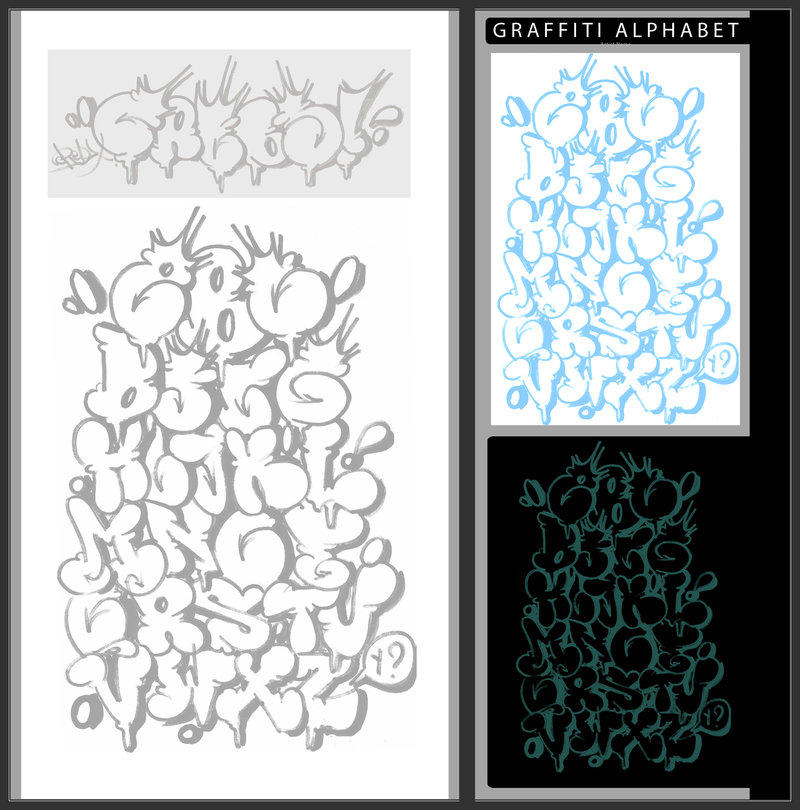
Street graffiti doesn't always have to be done outside. You can learn your tag alphabet by practicing on paper, slowly adding flourishes, and develop your own style. Many people begin by tagging their nickname, but to fully develop your style, begin by tagging the alphabet.

INSTRUCTION:

  • Using sketchbook and pencil, explore and pick up stylistic impressions. Whether Asian, Indian, Persian, or Arabic, think dynamically as you move fluidly. Think dramatic. Your tag is your signature, and just as you learn to sign a check, you've got to feel comfortable. Make sure that your alphabet remains legible.


  • Add elements of the tag by erasing the end of letters. You can add arrows to provide a sense of direction. Add flourishes such as swirls or appendages into the letter structure. Symbols can be added to your alphabet as well.


  • Since letters are so important, it's crucial to develop letter patterns. The best place for beginners is with bubble letters. Use a distinct circular motion from the wrist to the paper. Letters overlap but are not connected.


  • Once the sketch is adequate, use a solid line to outline the letters in marker. Use a dark color to add shadow, and a third, lighter color to add glow, such as stars, or a light source. Since the letters are fat, you can add symbols or extra writing inside of the letters. Use lowercase writing, or symbols that are special to you.


Graffiti Alphabet, graffiti letters, graffiti creator,bubble graffiti alphabet letters, graffiti tutorials for all .

Graffiti Alphabet Gallery


[photosmash id=1]

Wednesday, April 13, 2011

Graffiti is an aesthetic problem, essentially visual pollution.  It makes people feel that an area is rundown, and often
the presence of graffiti results in the appearance of  more graffiti. Graffiti comes in many different forms, from  random words scribbled in marker across street signs, to  large colorful pieces spray painted on buildings.  It may or
may not be related to gang activity, and it costs property  owners and government agencies money to clean it up.
Once a neighborhood looks uncared for, crime problems  tend to increase.  Graffiti causes serious economic
consequences as well as visual blight in our communities.  Nationally, graffiti causes about $8 billion in damage a year.  The problem of graffiti is prevalent in the University District.  The field documentation observed 76 properties with graffiti.  Graffiti was mostly seen in alleys on garages, trash dumpsters,  and on the backs of houses.  Focus group participants
frequently mentioned graffiti as a concern, saying that graffiti
is everywhere.  Suggested solutions range from fines to using
video cameras to prevent graffiti from occurring.  Residents
feel that the presence of graffiti negatively affects the physical
environment of the neighborhoods in the University District.

Related Blogs

Monday, March 28, 2011

Graffiti can impact communities in many visible ways. There is a wide range of markings, etchings, and
paintings that deface and sometimes completely ruins public and private property. Despite the common
association of graffiti with gangs, it can be found in cities and counties of all sizes including Arapahoe County
and the City of Centennial and is not gang related.
Graffiti is a crime, an act of vandalism, not an art form. As with other forms of vandalism, graffiti is not
routinely reported to law enforcement.
Graffiti is a growing concern throughout the Denver metro area. Graffiti vandals believe their actions are
harmless. In reality, graffiti affects homeowners, businesses, communities and schools. Graffiti is an eyesore that
can affect property values, burden tax dollars, and make residents feel unsafe. According to the Rocky Mountain
News, graffiti removal in 2006 cost Denver taxpayers approximately $1
million dollars.
In 2007, the Arapahoe County Sheriff’s Office investigated 320 reported
cases of graffiti vandalism. In the first three months of 2008, 126 reports
of graffiti have been reported.
The goal of the Arapahoe Sheriff’s Office is to remove graffiti within one
week of being reported. Citizens are encouraged to report graffiti on
public property by contacting the Sheriff’s Office at 303-795-4711. Individuals providing information that result
in the arrest and conviction of those responsible for graffiti vandalism in the City of Centennial and Arapahoe
County may be eligible for monetary awards.
Here are some Graffiti prevention tips:
• Keep up the neighborhood. Keep the appearance of a neighborhood clean and neat. Remove litter and
trash, fix broken fences, trim landscape, and ensure all lighting is working properly.
• Remove graffiti promptly. Rapid removal of graffiti is an effective prevention tool. Data shows that
removal within 24 to 48 hours results in a nearly zero rate of recurrence.
• Get educated on graffiti and other forms of vandalism and how these crimes impact communities.
• Organize a Neighborhood Watch Program in your community.

Thursday, March 24, 2011

Effective graffiti?removal products formulated for a variety of wall surfaces are available at hardware
and paint stores. Professional graffiti?removal contractors may also be used.
Follow manufacturer’s directions when using graffiti?removal products, as many are toxic. Several of the newer products are biodegradable and less
toxic. Be sure to wear rubber gloves, safety goggles, and an OSHA approved respirator while removing graffiti.

Some helpful tops can be found in various resources for removing graffiti, from a variety of surfaces are described below. Always test a small inconspicuous
area first!

* Brick, Cement, or Concrete: Use extra strength paint remover. Apply with a wire brush or some products come with a sprayer.

Scrub area with wire brush, and then allow to dry. Rinse with a forceful stream of water
from a hose. Some surfaces may have to be done more than once.

* Stucco: Apply extra strength paint remover. Seal area with “KILZ” and then paint over the

area with stucco paint. If the affected area has been tagged more than once, you should
sand blast the wall first.

* Aluminum Siding: “Goof Off” works quite well on latex paint, but not on oil?based paint. Oil?based paint siding can be cleaned up with

a full strength paint remover, but sparingly and carefully!

* Wood: On latex or oil?based painted wood use “KILZ” to seal the graffiti. Paint over

quickly so the graffiti won’t bleed through. If the area is stained and varnished, use paint remover with sprayer, and wipe off with a cloth rag.

* Fiberglass: Use a full strength paint remover and rinse carefully. Carburetor cleaner works

well

What is graffiti?

Graffiti is a public nuisance and a common form of  vandalism.   Graffiti vandals write, scribe, etch, or
spray?paint on many surfaces.  Graffiti perpetrators  are often associated with other criminal activities,
including violent crimes. A neighborhood plagued by  graffiti becomes unappealing to perspective
omeowners and tenants.  Not removing graffiti  encourages littering, violence and more graffiti.

<strong>Prohibited Acts </strong>
Defacement: It is unlawful for any person to apply  graffiti to any natural or man?made
surface on any  publicly or privately owned property.

Graffiti As Nuisance  The existence of graffiti on public or private property  in violation of
city ordinance is expressly declared to  be a public nuisance and therefore is subject to the
removal and abatement.  ¾  Duty of Property owner: It is the duty of  both the property owner and/ or the
occupant in possession of a property, to at all  times keep the property clear of graffiti. ¾
Perpetrator: The City may require the guilty  perpetrator to either remove or pay for the  costs
for the removal of the graffiti within  twenty?four (24) hours. A perpetrator may
be charged civilly, as well as criminally.

Script & Calligraphic Styles

Many tags consist of script and calligraphic styles. Some writers use objects that are
symbolic of their lives. Others simply use patterns or other elements for design purposes. One
of the most famous tag styles was done by Stay High 149. He drew his name with a smoking
joint as the cross bar in the letter “H” and included a stick figure. As tags became more complex
and more detailed, they became bigger and more noticeable.

Because the spray nozzle has a very small orifice, the only way for writers to make their tags
larger was to increase the thickness of the letters and do additional outlines. Writers realized
that by using nozzles from different aerosol products that they could get bigger and wider spray.
As thicker letters increased the effect, writers imaginatively designed the inside of the letters,
too.

Letters changed from the traditional thin style to bubbly, block, and leaning letters. Letters
were manipulated by the addition of characters such connections and curls. Arrows were added
to the ends of letters. This style of lettering became known as mechanical or wild – style
lettering. One writer, Phase 2, developed most of the new lettering styles through which graffiti
became recognized as an art form. The following are the lettering styles used by writers: CLICK HERE

Graffiti artists have had a great deal of freedom since the crack down several years ago
before municipal and other public budgets became extremely tight.  However, government is
again fighting graffiti.  Several cities are considering or have passed anti-graffiti laws.  Many of
these laws make it illegal for merchants to sell spray paint and broad tip markers to individuals
under 21 years old.  Some of these new laws make it illegal for individuals under 21 to possess
spray paint and broad tip markers.  Others yet have combined the two making it illegal to sell to
and possess.
Artists are fighting back.  Prominent people, such as Mark Ecko, a former graffiti artist turned
clothing and media magnate who founded New York-based Ecko Unlimited, is funding legal
proceedings fighting these new laws.  Ecko and his artist friends claim these bans are
unconstitutional because they limit free speech.  In time, the courts will decide who wins and
what happens.

Types Of Graffiti:
• MURAL:  Large and often called a “masterpiece.”  Motivation is artistic.  Illegal murals
are a small percentage of graffiti.
• GANG:  Not highly repetitive or artistic, designed to convey a message about territory or
a threat.  Usually confined to specific areas, so amount of vandalized property is
generally low.
• TAGGING:  Most graffiti falls in this category.  Taggers are individuals or groups, called
crews.  Taggers often leave initials or crew names.  Can be artistic or not.  Highly visible
and dangerous locations are prized.
• TOYS:  Refers to young people who are just beginning to tag.

Graffiti by Allen Merta

Graffiti has been around for centuries in many different forms. Cavemen placed some graffiti
on large stones and in caves on the walls. Political activists used graffiti to make statements.
Gangs use graffiti as a way to mark their territory and communicate.

Several authors providing a history of graffiti all seem to agree that the modern artwork
known as graffiti originated in Philadelphia during the mid – 1960s. Later in that same decade,
writers began to be recognized individually as writing became more prevalent.

Naturally, graffiti art migrated to other cities, especially New York City. Some of the first
artists to be acknowledged were Cornbread and Cool Earl, both of whom wrote all over the city.
Once Cornbread emerged in New York City, other writers followed in the Washington Heights
area of New York City. TAKI 183 became one of the pioneers of writings on the subway. TAKI,
whose real name is Demetrius and who lived on 183rd
Street, was a messenger who used the
subway frequently. Because of his accessibility to the subway, he began his career by doing
“motion tags.” The New York Times did an article about TAKI and his work because of his
unusual tags, name and number. Although he wasn’t the first writer, he was the first to be
identified as part of this new subculture.

Friendly Freddie kicked off the writing trend as the graffiti movement migrated to Brooklyn.
This is significant because it started an inter-borough competition.- everybody could see
everybody else’s work on moving trains. The writers tried to outdo each other.

Writing began to consist of “tags” and the goal was to have as many as possible traveling
around the city. These writers would ride the trains attempting to tag as many cars as possible.
Conversely, tagging trains in train yards and railroad lay-up yards is referred to as “Bombing.” It
is a faster place to work with less chance of being caught. It became important for each writer
to make his / her tags unique.

In the mid – 1970s when New York City was broke, the transit system was poorly
maintained. The heaviest bombing occurred during this period in history. Entire cars began to
be designed. The “throw up,” as it was called, was a style that was introduced as a way to
make letters quickly. The letters were outlined and barely filled in. The “wars” between writers
were peaking at this time, too.

One of the last big waves of bombing occurred in the late 70s. Then financial times got
better for major cities, including New York. The Metropolitan Transit Authority (MTA) started to
enforce the elimination of writing all over New York City.

By the 1980s, many writers ceased writing to begin real life careers. These artists and
others flocked to art galleries that introduced graffiti art overseas. This was also a time when
the culture of writing was diminishing in many ways and for many reasons. The streets were
becoming very tense and very unsafe because of drugs, guns, and violence. Laws were
enacted restricting the sale of paint to minors. Many stores were locking up paint, which
virtually eliminated shoplifting. Train yards and lay-up yards were more closely guarded as
were other “ideal” painting areas. Graffiti removal programs were in full effect. All of this made
many artists quit. For others, it made them more motivated. Because areas to write were so
scarce, violence became more prevalent in protecting and defending these “territories.”

The Metropolitan Transit Authority declared victory over graffiti in May 1989. In what has
become known as the Clean Train Movement, the MTA effectively removed all marked cars
from running.

Many writers believed that tagging on trains meant you were a “real writer.” If you tagged
walls, freight, and scraps, you were labeled as “a fake.” Throughout the years, writers have
kept fighting the MTA.

In more recent times, writers have been gaining recognition and have been featured in
various media. Magazines have been created graffiti and writers and a series of movies were
produced in the late 1980s in New York City. These movies were the first organized videos that
documented writing by writers.

In 1994, web sites emerged that focused on documenting writing as an art form. Media
exposure significantly increased a few years later. This further pushed graffiti as an art form in
a manner that took it off the streets and into galleries and museums.

Saturday, March 19, 2011

Graffiti removal techniques

It is best to clean graffiti as soon as possible so the paint doesn’t have time to absorb into the surface. It is worth it to keep paint or removal products on hand so that you can quickly paint over or remove the graffiti should it become necessary.
PAINTING OVER GRAFFITI

If a large portion of a property has been vandalized, it may be cheaper to simply repaint.  A $10 gallon of paint covers the average 100 sq. ft. garage door for an average cost of .10 a sq. ft. It will also give you the opportunity to change the paint to glossy enamel, which will resist future graffiti attacks better than a flat finish.  For added protection, an extra
gallon of the same type of paint will help ensure a quick and painless perfect match if graffiti returns.
Before painting, try to clean the surface of any dirt or grease.  Certain marker pens and indelible markers have the ability to absorb paint pigments. That’s what makes them permanent so use a special paint called a stain blocker.  Also, if the base color is light and the graffiti a dark color, use a stain blocker first.  This special type of paint prevents the darker paint from seeping through the fresh paint.

Oil or Latex Paint? Sealers?  Foam Brushes?

Oil base paint is tougher than latex.  Latex is cheaper and easier to clean up.  Though not recommended, oil base, can be applied at below freezing temperatures if needed.  Oil base takes
longer to dry, but can be used if light rain threatens.  Once the new paint is on, you might consider using a “sealer” or “protectorate.”  These types of products seal the small surface pores and prevent graffiti’s ability to adhere.  Once sealed, the new graffiti is easier to remove with less work. Some protectorate systems sacrifice a small amount of the sealer and need to be reapplied after the graffiti is removed. As a good insurance policy, buy some foam- type brushes.  If graffiti reappears, use the foam brushes and the new
paint will blend into the old with perfect results.
Then just toss the brushes away since they are inexpensive.

Graffiti offenders are typically young and male. In one study,most offenders were ages 15 to 23; many of the offenders were students. Offenders may typically be male, inner-cityblacks and Latinos, but female, as well as white and Asian, participation is growing.

The profile clearly does not apply in some places where the population is predominantly white. Tagging is not restricted by class lines.In Sydney, Australia, graffiti offenders, while mostly boys, include girls; offenders are typically ages 13 to 17.

In San Diego, all the taggers identified within a two-mile area were male, and 72 percent were 16 or younger
Graffiti offenders typically operate in groups, with perhaps 15 to 20 percent operating alone.

In addition to the varying motives for differing types of graffiti, peer pressure,boredom, lack of supervision, lack of activities, low academic achievement, and youth unemployment contribute to participation in graffiti.
Graffiti offenders often use spray paint, although they may also produce graffiti with large markers or by etching, the latter especially on glass surfaces.

Spray paint is widely available, easily concealed, easily and quickly used on a variety of surfaces, available in different colors with different nozzles to change line widths–these factors make spray paint suitable
for a range of offenders.

The making of graffiti is characterized by anonymity–hence relative safety from detection and apprehension. Most offenders work quickly, when few people are around. Graffiti predominantly occurs late on weekend nights, though there is little systematic evidence about this. In British transit studies, graffiti incidents typically occurred in off-peak or non-rush hours.

In Bridgeport, Conn., graffiti incidents were concentrated from 5 p.m. to 4 a.m. Thursdays through
Sundays.

A San Diego study showed that routes leading away from schools were hit more frequently, suggesting a
concentration in after-school hours Monday through Friday. Offenders tagged school walls daily.

There is widespread concern that participation in graffiti may be an initial or gateway offense from which offenders may graduate to more sophisticated or harmful crimes. Graffiti is sometimes associated with truancy, and can involve drug and/or alcohol use. Graffiti offenders who operate as
members of gangs or crews may also engage in fighting

Types of Graffiti

There are different types of graffiti. The major types include:
• gang graffiti, often used by gangs to mark turf or convey threats of violence, and sometimes copycat graffiti, which mimics gang graffiti;
• tagger graffiti, ranging from high-volume simple hits to complex street art;
• conventional graffiti, often isolated or spontaneous acts of "youthful exuberance," but sometimes malicious or vindictive; and
• ideological graffiti, such as political or hate graffiti, which conveys political messages or racial, religious or ethnic slurs. In areas where graffiti is prevalent, gang and tagger graffiti are the most common types found. While other forms of graffiti may be troublesome, they typically are not as widespread. The
proportion of graffiti attributable to differing motives varies widely from one jurisdiction to another.

The major types of graffiti are discussed later.

Thursday, March 10, 2011

Graffiti Art Effects - TUTORIAL

First you need an brick wall as a background. You can search the image on the Internet.


Open a new file having 1024×768 px and 72 dpi.


You may use a brick wall as a background for the picture.


Press on Shift button and make use of the next instrument

to represent a lot of circles colored in 5D4D4D.


Now select the shape in overlay mode.


Insert the same way a lot of other circles, colored this time in 606060.


Set Overlay on the shape too.


Using the same instrument applied before. represent one more layer of circles colored in 568F8F.


Fill 70% on the layers and set Overlay option for them.


Write now the site’s name


Set this time Hard Light on the layers.

Blending Options-Drop Shadow


Select a brush with blurred edges on a new layer and try to draw several patches on the picture. They should have different colors – 5C0003 and 160F2B.


Set Overlay on the layers.


Draw on a new layer several yellow patches and select the option Filter Liquify to make everything look like in the picture (the colors should be blurred out with SmudgeTools(R) and unnecessary elements may be erased with the usual instrument.


And the grand finale

Sunday, March 6, 2011

Graffiti Stencil Tutorial

1. Choosing your image
First thing first, you need to choose an image that will make a good stencil (or draw your own). To much detail is hard cu cut and and the stencil will become weak.

2. Designing the stencil
The next step is to pick out the darkest and lightest parts of image. Another method is to use photoshop to make the image high contrast and black and white.

3. Islands and bridges
So leave small gaps/ bridges to all the white bits.Say you have black around the eyes, but you want the white bite left. Leava a gap in black. This will connect it to rest of the face. This will come naturally after some tries and mistakes.

4. Careful cutting
Cutting out your graffiti stencil is probably the most fiddly bit. Here are some tips to stay safe:
a. Go slow and cut lightly
b. Always cut away from yourself
c. Make sure your hand is behind the blade that way if you slip you won`t cut your finger.

5. Spraying your stencil

One you`re happy with your stencil, it`s time to spray! Think about the surface/material you want your image on (t-shirt, bag, wall ,poster...). Spray quickly and evenly from about 15-25 cm away, otherwise the paint will drip (unless you want drips).Wait 30 secs until the paints dry and lift off your stencil to see your design.
A number of words and phrases have come to describe different styles and aspects of graffiti. Like other jargon and colloquialisms, some phrases vary in different cities and countries. The following terminology comes primarily from the United States.
Graffiti on the Berlin Wall

all city
The state of being known for one's graffiti throughout a city. Originally, this term meant to be known throughout the five boroughs of New York City through the medium of subway cars.

back to back
Graffiti that covers a wall from end to end, as seen on some parts of the West-Berlin side of the Berlin Wall. Similarly, trains sometimes receive end to end painting when a carriage has been painted along its entire length. This is often abbreviated as e2e. End to ends used to be called window-downs but this is an older expression that is falling from popularity.

backjump
A quickly executed throw up or panel piece. Backjumps are usually painted on a temporarily parked train or a running bus.

black book
A graffiti artist's sketchbook. Often used to sketch out and plan potential graffiti, and to collect tags from other writers. It is a writer's most valuable property, containing all or a majority of the person's sketches and pieces. A writer’s sketchbook is carefully guarded from the police and other authorities, as it can be used as material eviden ce in a graffiti vandalism case and link a writer to previous illicit works.[1]

bite
To steal another artist's ideas or lettering schemes. Seasoned artists will often complain about toys that bite their work.[2][3]

bomb
To bomb or hit is to paint many surfaces in an area. Bombers often choose throw-ups or tags over complex pieces, as they can be executed more quickly.[3][4]

buff
To remove painted graffiti with chemicals and other instruments, or to paint over it with a flat color.[2][3]

burn
To beat a competitor with a style.

burner
1. A large, more elaborate type of piece. The piece could be said to be "burning" out of the wall or train-side. Because they take so much time and effort, burners in downtown areas are more likely to be legal pieces, painted with the consent of the property owner. The early writers of New York also did burners illegally on trains, and adventurous modern writers sometimes still do large scale illegal pieces in heavily-trafficked areas.[3][5]
2. More recently, any quick chrome bombing or throwup.[citation needed]

burning
Any work having not been removed. "That piece is still burning on main street."

cannon(s)
A slang term for spray paint cans. This term is thought to originate in Brooklyn, New York.

cap
To cross out or in any other way ruin a piece made by others. Derives from a writer named "Cap" who was infamous for making throw-ups over others' pieces.

crew
A crew, krew, or cru is a group of writers or graffiti artists. Some crews are members of gangs or are associated with gangs (sometimes for procurement of art materials or for protection while painting), but most crews are unaffiliated with gangs. Any group of friends can form a crew if they are interested in graffiti and want to start collaborating. There is a smaller risk of being held responsible for crew works if a single member gets arrested. From a legal point of view, the name could have been painted by anyone in the group.[2][3]

dress-up
To completely write all over a specific area like a door-way, wall or window that is untouched.

dubs
London/UK style of graffiti executed in silver or chrome paint. Usually on railway walls or street locations, it is done quickly by a crew or group of writers.

end-to-end (...)
The opposite of top-to-bottom - meaning a train-car covered with paint from one side of it to the other. Used as an adjective and non-commonly as a noun.[6]

etch
The use of acid solutions intended for creating frosted glass, such as Etch Bath, to write on windows. In Norway some trains have even been taken temporarily out of service because of the acid tagging, which is potentially dangerous for other people's health.[7]

fills
Also referred to as "bombs" "throw ups" or "throwies". Fills describe a piece of graffiti that is either filled in a rush or a solid fill. A fill is also the interior base color of the piece of graffiti.

gallery
Locations such as overpasses and walls facing train tracks that are secluded from the general public but are popular with writers. Since anything that is written is likely to stay for a while, an accumulation of styles and skills can be viewed.

going over
To "go over" a piece of graffiti simply means to paint on top of it.[3] While most writers respect one another's artwork, to intentionally and disrespectfully paint on top of another's work is akin to a graffiti declaration of war. However (due partially to the limited amount of desirable wall-space) most graffiti writers maintain a hierarchy of sorts; a tag can legitimately be covered by a throw-up, and a throw-up by a piece, and this is commonly done without incident. If a piece has previously been slashed (or "dissed"), it is also acceptable for another writer to go over it. To violate these guidelines, or to simply paint lower-quality graffiti on top of a higher-quality artist's work will quickly characterize a writer as an annoyance, or "toy." This is thought to be dangerous as a few remarkable crews are rumored to be physically violent to people not respecting their self-claimed rank in the hierarchy. also: hot 110[8]

getting up
to work your reputation or "rep" through graffiti. (see King)
(For more information check this link: http://en.wikipedia.org/wiki/Graffiti_terminology )

Tutorial Graffiti 3D

[youtube http://www.youtube.com/watch?v=E7zqEvJXjHQ&w=340&h=390]
wildstyle
Graffiti with text so stylized as to be difficult to read, often with interlocking, three-dimensional type.

Graffiti Style Writing Tutorial

his tutorial was inspired by 'Writing-Styles' a recent dev. But so its not confused, the style written in 'Writing-Styles', is my own freehand, and not altered as the 'SICK' tag in the tutorial. My tips and tuts/ are exactly what they say & are, tips & quickies, I have spent 100's of hours perfecting what I do, & yet, Its still not perfected. So don't get mad at me if anything doesn't work for you. PRACTICE!!!!!!! (for more information click here) @ Graffiti Style Writing Tutorial

Wednesday, March 2, 2011

Retrospective of Graffiti alphabet

Graffiti (singular: graffito; the plural is used as a mass noun) is the name for images or lettering scratched, scrawled, painted or marked in any manner on property. Graffiti is any type of public markings that may appear in the forms of simple written words to elaborate wall paintings. Graffiti has existed since ancient times, with examples dating back to Ancient Greece and the Roman Empire

In modern times, paint, particularly spray paint, and marker pens have become the most commonly used graffiti materials. In most countries, marking or painting property without the property owner's consent is considered defacement and vandalism, which is a punishable crime. Sometimes graffiti expresses social and political messages and a whole genre of artistic expression is based upon spray paint graffiti styles. To some, it is an art form worthy of display in galleries and exhibitions; to others it is merely vandalism. Graffiti has evolved into a pop culture existence often related to underground hip hop music, b-boying, and a lifestyle that remains hidden from the general public.[2] Graffiti can be used as a gang signal to mark territory or to serve as an indicator or "tag" for gang-related activity.

Controversies that surround graffiti continue to create disagreement amongst city officials/law enforcement and graffitists who wish to display and appreciate work in public locations. There are many different types and styles of graffiti and it is a rapidly developing artform whose value is highly contested, reviled by many authorities while also subject to protection, sometimes within the same jurisdiction.
These graffiti alphabet letters are added for your help as quickly as you can see the evolution.

Sunday, February 20, 2011

Bubble letters alphabet

Graffiti Alphabet


Graffiti Alphabet - KREDYART.COM RO. @ COPYRIGHT 2011

Saturday, February 19, 2011

Graffiti Stencil

tencil graffiti makes use of a paper, cardboard, or other media to create an image or text that is easily reproducible. The desired design is cut out of the selected medium and then the image is transferred to a surface through the use of spray paint or roll-on paint.

The process of stenciling involves applying paint across a stencil to form an image on a surface below. Sometimes multiple layers of stencils are used on the same image to add colours or create the illusion of depth.

Those who make and apply stencils have many motivations. For some, it is an easy method to produce a political message. Many artists appreciate the publicity that their artwork can receive. And some just want their work to be seen. Since the stencil stays uniform throughout its use, it is easier for an artist to quickly replicate what could be a complicated piece at a very quick rate, when compared to other conventional tagging methods.